Showing posts with label mantras. Show all posts

Wednesday, 2 February 2022

Grant MacEwan, The Language and Literature of Yoga

Namaste ЁЯЩП 

There is a saying in Sanskrit, the original language of Yoga that in any learning environment:

We learn 25% from our teachers, 25% from our peers, 25% we figure out ourselves and 25% we learn over time. 

That said, in addition to following along with this post in today’s class, I invite you to return and review the material and links, contemplate their relevance in your life and practice, and discuss them with your classmates. 

Rest assured, not all of it was meaningful to me from the beginning, and there is always more to learn, so if some of this feels like more than you’re ready for, that’s ok, you have a lifetime to practice.

I have included several questions for your consideration. Please feel free to voice your answers or further questions for discussion during class.


The Language and Literature of Yoga


Sanskrit is the primary classical language of India, and the original language of Yoga which is considered to be one of the six classical schools of Indian Philosophy, and includes the posture practice with which we are familiar.

The word Sanskrit means "perfected" or "refined" and has a rich tradition of creative, scientific, philosophical and religious texts. 

Although it is no longer widely spoken on a daily basis, it is still very much in use as a ceremonial language.

The beautiful script is known as Devanagari, or the "vehicle of the gods". 

The Cambridge Introduction to Sanskrit  is the best introductory text I have come across and is recommended for use in the Sanskrit classes at the University of Alberta. Click in the link and go to “Other Resources “ to find free alphabet charts, videos, worksheets and more.

Yoga Sutras in Devanagari and Transliterated Sanskrit from the Arlington Centre is a free PDF of the full Yoga Sutras of Patanjali with the diacritical marks. I’m not necessarily saying this is the “best” translation, but I do find the format and language approachable and helpful for beginners.

Q. Does language matter? Do names matter? What are some of the challenges and benefits of studying Yoga with or in the original language?


Transliteration Vs. Translation


Transliteration is transposing the sounds of one language into the script of another.  The use of standardized diacritical marks allows for accurate representation of sounds unique to a language.

Q. What challenges may a student encounter during the transliteration phase?

Translation is converting the words of one language into the words of another to facilitate understanding of the meaning of words or phrases. 

Q. What challenges may a student encounter during the translation phase?

Sanskrit in Modern English

English is a member of the Indo-European language family, one of several descendants of Sanskrit.

Many non-yoga specific words in English (jungle, bandana, pyjama, suture, jugular etc.) are borrowed or derived from Sanskrit. 

Many Sanskrit terms specific to yoga are becoming well known in English through the names of postures, authors, teachers and gurus.  Because their meanings may become lost in translation, often the original words are simply adopted into our modern language.

Here is an extensive and perhaps surprising list of English words of Sanskrit origin.

Q. What’s your favourite English word borrowed or derived from Sanskrit ?


Hints for Pronouncing Sanskrit Words and Names


Here are a few basic tips for pronouncing unfamiliar Sanskrit vocabulary, places and names:

- unlike English, Sanskrit is a phonetic language, meaning each and every letter is pronounced and always in the same way.

- transliterated letter "a" is pronounced "uh” as in "around" rather than "a" as in "after" or “Canada”

- each consonant is followed by a short “a” sound unless modified by other vowels. Letters do not have names in Sanskrit, they are known by their sounds.

- knowing where in the mouth the sound is produced will help you understand how to produce the sound

- there is a distinct and unfamiliar difference for English speakers between unaspirated and aspirated consonants ("b" vs. "bh" etc.)

- Sanskrit has no "th" sound, as in English “think" or "th" as in "this".  Rather the “th” in transliterated words indicates an aspirated consonant. For example, the word "Hatha"is pronounced "ha-tha" (“t" with a puff of air) rather than the common English mispronunciation of "Ha" (as in hat) "tha" (as in thug). Note* there are two such sounds which may seem similar to your ear but are actually produced in different areas of the mouth.

- longer words and names are often compounds of shorter words, so try breaking them down into syllables.

Here is a more extensive pronunciation guide should you wish to explore this matter further.

Q. What difficulties may arise when words or names are mispronounced?

Q.  What are some benefits of speaking more than one language?

Foundational Literature

Foundational texts are works of world literature which achieve a certain status for their presentation of ideas as representative of a culture or philosophy. 

Philology is the study of literary texts, their meaning, authenticity and historical context.


The Foundational Texts of Yoga
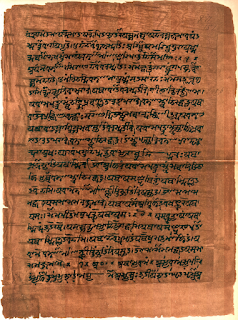

The Vedas

Meaning "wisdom" or "knowledge", the Vedas are traditionally said to be the revelations of sages during deep meditation, carefully preserved and considered to be the roots of Indian philosophy.

They are among the oldest sacred texts in the world, written approximately 1700-1100 BCE.

They were transmitted by oral tradition alone until around 1000 CE. They emphasize formal ritual and rites of passage like marriage, birth and death. 

They also introduce dana (compassion), karma (action and reaction), sacred dance and Ayurveda (sister sciences of yoga).

The Upanishads

Upanishad means “to sit at the feet” [of a Guru].

There were approximately 200 Upanishads written between 1000 BCE and 1500 CE including sections on philosophical theory and the practice of virtues like satya and ahimsa later also elucidated in the Yoga Sutras of Patanjali.

Topics include consciousnessbrahman, atman and maya, or the Source, the Self and the illusion that keeps us from seeing them as the same. It also proposes multiple etymological possibilities for Bija or “seed” mantra Om (Aum)

Of the great statements or mahavakyas of the Upanishads is Aham Brahmasmi, or loosely translated, "The Self and the Divine are one and the same." A similar sentiment can be said to be encapsulated in the sound symbol Om.


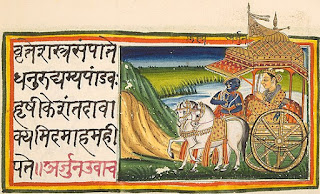
Arjuna and Krishna, the main characters in the Bhagavad Gita

The Bhagavad Gita

Written approximately 400 BCE, this text is just one chapter of an epic poem called  The Mahabharata.

It is one of the most heavily translated texts in the world. It highlights themes of  Dharma(duty and heroism), Yoga (and the paths of yoga, KarmaJnana and Bhakti), Moksha or liberation from suffering and the cycles of suffering on the “battlefields" of life.


One key definition of yoga in this text is:

Yoga karmasu kaushalam (Yoga is skill in action.) found in Chapter 2 verse 50.
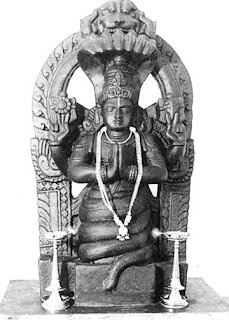

The Yoga Sutras of Patanjali

Also known as the Patanjala Yoga Shastra, written approximately 1600 years ago, (perhaps as late as 325-425 CE suggests recent research by Dr. Philipp Maas), Patanjali was the first to codify the teachings of yoga into a written format known as Sutras. Ideally these terse aphorisms are studied in the original language along with the first commentary called the Yoga Bashya.

Yoga Studies Podcast, Philipp Maas

Yoga Sutra Chant, The Sanskrit Channel

One of Patanjali’s key definitions of yoga is stated in the second line of the first chapter:

Yogaschittavrittinirodhah (Yoga is the stopping of the disturbed waves of the mind.)

In the second chapter, the author famously outlines a strategic "eight-limbed" path of practice which moves from external practices (yamas, niyamas, asana, pranayama, pratyahara) to internal experiences (dharana, dhyana, and samadhi). The path is known as Ashtanga or Raja Yoga. This practice is widely regarded as central to modern Hatha Yoga.

The sound symbol Om is mentioned in chapter 1, sutras 27-28 as the energy of manifestation which should be chanted repeatedly (japa) to encourage introspection and remove obstacles to the state of samadhi.

Q. How do these “definitions” compare/contrast with the modern interpretation of yoga in Canada?

Q. Is reading these texts in their original language necessary to achieve the goal of yoga?

Please note* This is by no means a full list of the foundational texts of yoga! It is only the tip of the tip of the iceberg! Please do explore further.

Krishna playing his flute


Mantras, Stories and Songs

Traditionally, Yoga was an oral tradition, passed from person to person keeping the teachings both alive and lively.

Singing, chanting, poetry and recitation, in fact all forms of sound, speech and writing are venerated in yoga philosophy. Personified as a beautiful Goddess, language is seen as a muse for creativity.

Storytelling is used widely as a teaching tool for students of all ages.

Music and sacred sound are central to the theory-practice continuum. They attract the attention, help maintain focus, reset dissonant physical and mental vibrations and uplift the environment.

Q. How can some knowledge of Sanskrit enhance my experience of yoga?


In Conclusion

I hope that I have passed on to you some of the reverence and enthusiasm I feel for the Language and Literature of Yoga, as well as points for reflection and some resources with which to follow up on your curiosity. 

Thank you for your time and attention today. Namaste!


Wednesday, 22 February 2017

You Can Learn to Read Sanskrit

The Rig Veda in Devanagari Script
I just came across this extremely helpful series of videos on YouTube for all of you who are interested in learning to read Sanskrit!

You may be wondering, "Um, Tara... why would I do that?  Isn't Sanskrit a difficult language?  Who has time for that?  Can't I just stick with translations?"

If you would like to experience the full benefits of yoga I encourage you to make a little effort in this matter.  It's not as difficult or as time consuming as you think to learn the sounds and read simple words and mantras.

Translations inevitably reflect the bias of the translator.  Yoga encourages us to use our intellects to study, and also to verify and integrate those learnings through our own experience.

Therefore, I think it is well worth the effort to compare translations and better yet, form your own interpretations of foundational texts based on knowledge of the original language, the wise counsel of your most trusted teachers and your own reflection and life.

The sounds of Sanskrit, which is described as a "perfect" language, have a resonance which may be diluted when mispronounced or when heard only in translation.  Even if you have no intention of becoming a Sanskrit scholar, you can benefit from the "good vibrations" of the sounds and the energies they invoke.

So go for it!


Learn to Read Sanskrit, Lesson One

Learn to Read Sanskrit, Lesson Two

Learn to Read Sanskrit, Lesson Three

Learn to Read Sanskrit, Lesson Four

Learn to Read Sanskrit, Lesson Five

Learn to Read Sanskrit, Lesson Six

Just in case you're still dubious about your ability to grasp this, check out these British schoolchildren reading, writing and chanting in Sanskrit!


Tuesday, 15 September 2015

Mantra Music and Meditation, Friday September 18, 2015


Friday, September 18 from 7-8:30pm please join me to launch a monthly satsang at Yoga Within!

Let's share yoga songs and silence promoting peace, unity and serenity.

Next date: October 23, 2015

Tuesday, 8 July 2014

The Power of Sacred Sound, July 19, 2014

Saturday, July 19, from 2-4 pm join me again at Yoga Within to experience the Power of Sacred Sound!

Nada Yoga, the Yoga of Sound, uses mantras, chanting, singing and storytelling to purify our hearing and speech, raising our vibrational resonance in the world and within.

Nada Yoga embraces the notion that the basic stuff of the universe is vibration. 

By attuning our resonance with it, using verbal, instrumental and subtle sound as a medium for meditation, we can not only enjoy, but elevate our lives.

No musical experience necessary!

Monday, 23 June 2014

The Power of Sacred Sound, June 27, 2014

Tibetan Singing Bowl, with Engraved Tara
This Friday, June 27, from 7-9 pm join me at Yoga Within to make some joyful noise!

Nada Yoga, the Yoga of Sound, uses mantras, chanting, singing and storytelling to purify our hearing and speech, raising our vibrational resonance in the world and within.

Nada Yoga embraces the notion that the basic stuff of the universe is vibration, and that by resonating with it, using verbal, instrumental and subtle sound as a medium for meditation, we can not only enjoy, but elevate our lives.

No musical experience necessary!

Wednesday, 28 May 2014

Ayurvedic Tea for Your Dosha


Cardamom, Cloves, Licorice, Cinnamon, Roses, and Fennel
 Ayurveda is the sister science of yoga, practiced in India for more than 5000 years.  Some say it is the world's oldest health care system! 

Ayurveda promotes vitality by removing toxins from the body, and harmonizing body, mind and spirit using foods, spices, herbs, and mantras.

You can determine your personal Dosha or constitution by taking this Dosha Quiz from the Chopra Center or this one from Doctor Oz or this one from Yoga Journal.

Ayurvedic teas are a wonderful way to introduce this ancient wisdom to your life.  They are delicious, and easy to make from herbs and spices in your garden, whole foods store, or your favorite Indian grocer.

Here are three recipes that calm and energize the body and mind without caffeine.  They also promote healthy digestive and immune systems. 

Click here for the recipe source and more information about their indications and benefits.

Vata Chai:  Licorice root, cinnamon, ginger, cloves, fennel, and stevia.

Pitta Chai:  Licorice root, rose petals, fennel, cardamom, ginger, and stevia.

Kapha Chai:  Ginger, licorice root, cinnamon, cloves, black pepper, and cardamom.

Drink to your pleasure and health!

Wednesday, 2 April 2014

Evening in Tibet, Saturday April 5, 2014


This is your last chance to purchase for tickets for Gaden Samten Ling's annual fundraising Evening in Tibet, dinner and silent auction!

- Live music!

- Tasty traditional Indian food!

- Unique silent auction items!

Sparrow, singing kirtan style Buddhist mantras featuring original music she wrote especially for this event!

- Live auction for a one-of-a-kind fabulous butter sculpture by Kushok Lobsang Dhamchoe!

Don't miss it! 

Thursday, 7 February 2013

This Weekend at Yoga Within

There are still a few spots available for this weekend's workshops at Yoga Within!

February 8 - 9 ~ Sanskrit for Absolute Beginners with Tara Woltjen

$82.50 + GST

Friday, February 8,  5:30 – 8:30pm (3hrs)

and Saturday, February 9,  1 – 4pm (3hrs)

The Sanskrit letters are said to be the sounds of the inner winds heard by the ancient yogis in deep meditation. Learn the basics of Devanagari script and transliterated Sanskrit in an easy, lighthearted way so that you too can resonate with these sacred healing sounds.

February 9 - 10 ~ Mantra Yoga the Complete Science with Yogi Amandeep

Feb 9th  - 1-6pm  $65, at door $75
Feb 10th – 10-2 pm $55, at door $65
 
Cost: for both days $111
  Mantra Yoga is perhaps one of the most ancient ways of self realization. “Man” means mind and “tra” means wave, Mantra is that which controls the waves of the mind.

According to the metaphysical science Mantras are primal sounds that alter the patterns of the mind and brain chemistry. Mantras are living conscious energy and have to be awakened to fully benefit from the sound, a process closely guarded secret.

The chanting of Mantras create blissful and peaceful mind. They bestow upon us the power to attain our goals and lift ourselves from the ordinary to the higher level of consciousness.  They give us the power to heal, attract prosperity, abundance and health. 

A very unique workshop on the detail science of mantra, how to awaken them, how they work, different forms of mantras, different stages in practise, their physiology in the body, their seats in the chakras, activation of 72,000 Nadis, their imprint in the mind and the whole science of mantra perfection.

Wednesday, 9 January 2013

Kirtan with Sparrow at Yoga Within

I'm so excited to be joining Sparrow this Friday evening for Kirtan at Yoga Within

Come sing along!

Friday, January 11, 2013

Kirtan with Sparrow Grace

7:30 p.m. - 9:00 p.m.

$20 + GST

"Sparrow is a Canadian singer songwriter and kirtan artist. She offers musical experiences featuring her original world folk art songs blended with uplifting, moving kirtan, mantras and chants."

Tuesday, 16 October 2012

Happy Navaratri!

Durga Ma
Tonight is the beginning of Navaratri, nine nights of annual celebration dedicated to the Divine Mother!

For three days, we celebrate the Divine Feminine in the form of Durga, the fierce warrior who clears away the demons of our ignorance. 

Then for three days we honor Lakshmi, the beautiful and generous Mother who bestows wealth and abundance.

The last three days are dedicated to Saraswati, the embodiment of wisdom and creativity.

Durga Ma
There are many ways to honor Shakti, or the creative feminine power within and around you. 

You may like to place reminders around your home or workplace in the form of flowers, images, or symbols.
 
One such tradition is to wear clothes in particular colors for each of the nine days. 

Durga Ma


Just in case you want to coordinate your "Saris" with the Divine Mother this Navaratri, here's the official listing for 2012. 
 
Please note:  This advice is in no way intended as a substitute for spiritual or sartorial counseling! ;-)
  
Image Source: Wikipedia
 
Tuesday October 16: Red
 
Wednesday October 17: Sky Blue
 
Thursday October 18: Yellow
 
Friday October 19: Green
 
Saturday October 20: Grey
 
Sunday October 21: Orange
 
Monday October 22: White
 
Tuesday October 23: Pink
 
Wednesday October 24: Blue


Friday, 29 June 2012

Blessings for a Beautiful Summer

Lakshmi by Betsy Schott
Lakshmi is revered as the goddess of beauty, abundance and prosperity.  She represents wealth in both material and spiritual matters.

As we enter the second half of 2012 and the beginning of summer, I wish health, wealth, spiritual awareness, freedom from misfortune, happiness, love, gratitude and generosity to all!

To invoke the energy of Lakshmi you can chant:

Om Sri Maha Lakshmyai Namaha

Or you can learn her Gayatri mantra by watching this video on YouTube.

Jai Ma!


Wednesday, 6 June 2012

Soham: I am That

Soham is an abstract or formless mantra, a mantra "without qualities".

Like the bija mantra Om, it doesn't invoke any particular deity.  Rather, it invites us to recognize our unity with the absolute or infinite nature of the universe.

The formless mantras are among the oldest, originating in the Vedic texts.  Yet we repeat this mantra naturally with each and every breath, "Soh" as we inhale, and "Hum" as we exhale.

As such, this universal mantra calms the body and mind, helping us to "Be Here Now".


Try concentrating on the sound of "Soh" as you inhale and feel the energy rising from the base of the spine along the sushumna nadi toward the crown.  As you exhale "Hum", feel the energy descending from the crown to the base of the spine. 

For a more detailed explanation of how to use this mantra in meditation, click here to visit swamij.com.

Although the vibration and the awareness are more important than the translation, the meaning is So-Aham, I am That or That I am.

Saraswati with Swans


This mantra helps the meditator realize that s/he is existence itself, timeless and without limitation of qualities or form. 

It is used mainly by experienced yogis and those who do not identify with a particular personification of the divine. 

It is sometimes referred to as the Hamsa mantra meaning "swan", a symbol of purity, prana, detachment, spiritual realization, escape from samsara, and identification with the Atman or Highest Self. 

Mantras for Precarious Times


Deep gratitude to Deva Premal and Miten for this!  Listen here or see the video on YouTube


Friday, 16 March 2012

Mercy Songs

mercedes bahleda - Mercy Songs
If you've been coming to my Yoga of Lady Niguma classes on Sunday mornings, you've heard Mercy Songs by Mercedes Bahleda. 

Mercedes is one of my dharma sisters, a fellow student of Geshe Michael Roach and Lama Christie McNally.  She is currently part of the hard-working entourage assisting Geshe Michael with his Diamond Cutter Institute tour, workshops and classes.

Many of you have asked me how you can get your own copy, so here's the link! 

"Mercy Songs" by Mercedes Bahleda is available through White Swan Music.

Mercedes has posted several of her beautiful songs on YouTube, including the video below featuring the Mantra of Chenrizig, the Bodhisattva of Compassion, Om Mani Padme Hum. 

Tuesday, 6 March 2012

Om Mandala Painting


Beautiful inspiration for our Likhita Japa!

Om...

"The benefits of Mantra-writing or Likhita Japa cannot be adequately described. Besides bringing about purity of heart and concentration of mind, mantra-writing gives you control of Asana, control of Indriyas, particularly the sight and the tongue, and fills you with the power of endurance. You attain peace of mind quickly. By prolonged and constant practice the inherent power of the Mantra (Mantra-Sakti) will be awakened, which will fill your very existence with the Divinity of the Mantra."

- Swami Sivananda, an excerpt from the book, Japa Yoga.