Its that time again! Join the festivities for Janmashtami, Lord Krishna's Birthday on August 16/17, 2014 at the Bhartiya Cultural Society and the Radha Govinda/ISKCON Temple.
Showing posts with label sweet. Show all posts
Showing posts with label sweet. Show all posts
Wednesday, 6 August 2014


Monday, 3 March 2014
Natural Beauty: DIY Sugar Scrub
 |
| My homemade Vanilla Sugar Face and Body Scrub |
You can do something about it without a trip to the beach, the spa, or even the mall.
Creating and customizing your own Lip, Face and Body Scrub is easy and fun. The main ingredient? Sugar!
Yes! Sugar (when used externally) is alpha-hydroxy rich which promotes healthy glowing skin.
Sugar scrubs gently clean and exfoliate, promote healthy circulation, moisturize and soften the skin. They eliminate the need for separate body wash and moisturizer, and are far less dehydrating than salt scrubs.
Making your own bath and body products from natural, food-based ingredients means no yucky toxins absorbed into the skin or harming the environment. You'd be surprised how many commonly used cosmetics you can make at home. Check out these 15 DIY Beauty Recipes from Food-based Ingredients from Care2.
This Sugar Scrub is safe for all skin types and gentle enough for use on body, face, and even lips.
What you need:
1/2 cup sugar. You can use white sugar, raw sugar, brown sugar, whatever you've got.
2 Tbsp. oil. My favorite is coconut but any will work.
1 tsp. vanilla extract (optional).
You are welcome to use essential oils instead, but I like to use food grade extracts for this recipe. For one thing, they're less expensive. After all, you're just going to rub this on your skin and wash it down the drain. And second, they're edible.. you know... ummm... just in case a little bit of your sweet, yummy smelling lip scrub accidentally gets past your lips...
What to do:
- Mix the sugar, oil and vanilla together with a fork or your fingers.
- Put it in a non-breakable container. (No glass or ceramics in the shower please.)
- Gently scrub all over wet skin a little bit at a time.
- Rinse off and pat yourself dry.
This recipe makes enough for two full-body scrubs. Enjoy!
Monday, 22 July 2013
More Fruit and Flower Infused Waters
 |
| Fruit and Flower Infused Waters |
They're so pretty, frosty cool, and delicious too!
On the left: Cherry and Marigold (next time I would cut the cherries)
On the right: Nectarine and Day Lily
What combinations have you come up with?
Sunday, 21 July 2013
Fruit and Flower Infused Waters
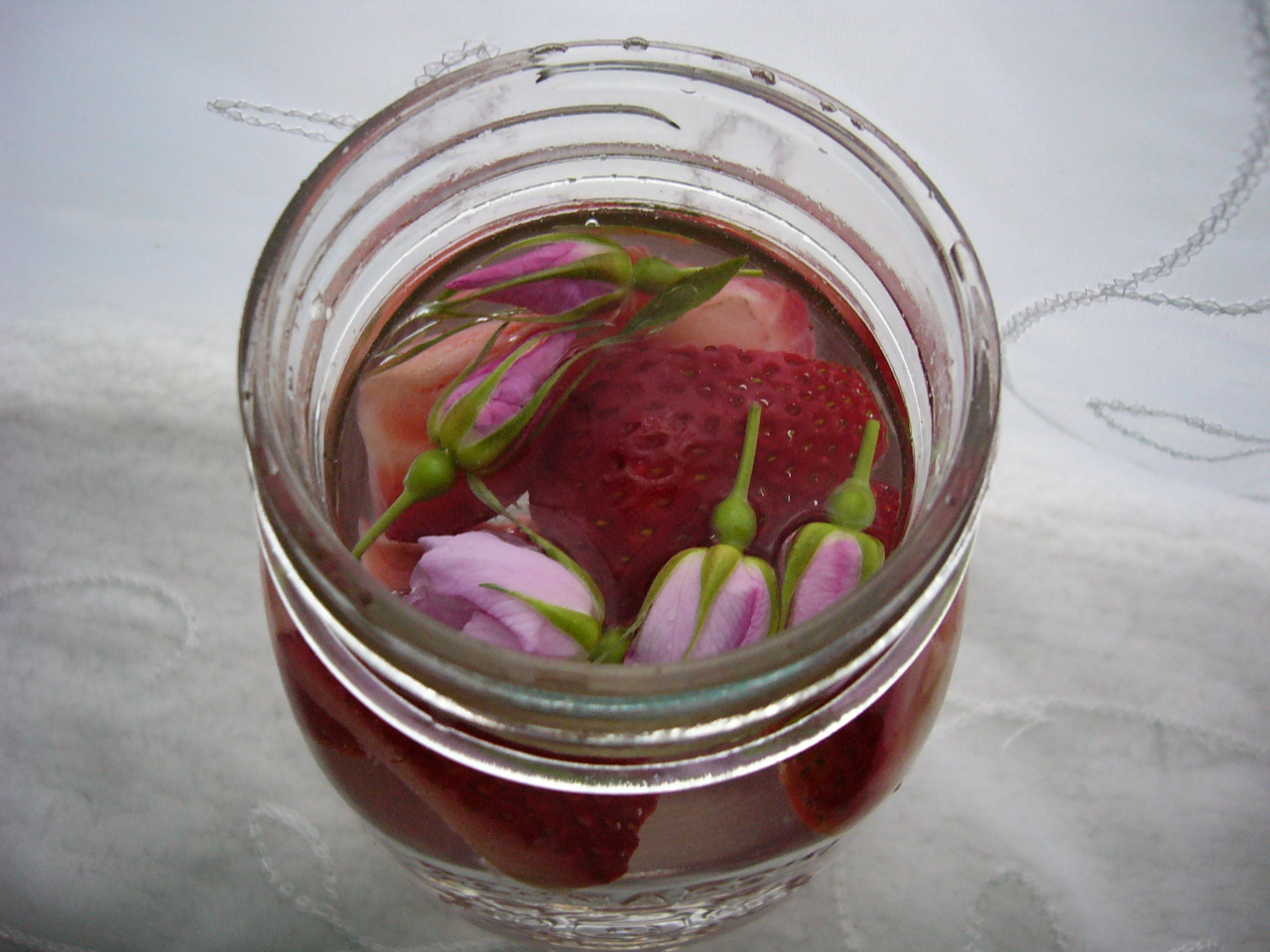 |
| Strawberry and Wild Rose |
You can make plain water pretty and delicious as easy as 1, 2, 3!
1. Add a few pieces of fruit and some edible flowers to your water glass or pitcher.
2. Infuse for a few hours.
3. Enjoy!
 |
| Blueberry and Lilac |
42 Flowers You Can Eat
Watermelon Hibiscus Water
Jasmine Infused Water
Lavender Water, DIY Infused Water Station
What's your favorite infused water recipe?
Tuesday, 17 July 2012
Sugar Beet Salad

What you need:
- 1 large sugar beet
- 1 large handful of mint
- 1 small handful of sunflower seeds
- 1 small handful of dried cranberries
- Pickled carrots

- Wash and trim the beet and mint.
- Grate the raw beet.
- Chop the mint.
- Cut the pickled carrots into slivers.
- Add the sunflower seeds and cranberries.
- Mix together and serve!
Monday, 2 July 2012
Sweet Lime Soda

I can't get enough Sweet Lime Sodas!
They were also the first culinary souvenir I recreated for family and friends back home.
They come in sweet and salty varieties, but the sweet one is most likely to appeal to our western lemonade palates.

- 1 Tbsp. lime juice or the juice of half a small lime.
- 1-2 Tbsp. raw sugar or simple syrup to taste.
- Club soda or sparkling water.
What to do:
2) Top up with club soda or sparkling water.

Well, you don't really have to trust me... lol!
After all, in yoga shraddha is all about personal experience, so you're welcome to try it for yourself!

You can also experiment with flavored sparkling waters.
I made the one on the left with mint sparkling water and presto - Easy Virgin Mojito!
Yum!
Thursday, 8 December 2011
Sweet Honey Chai...

I just had my first cup of Chai sweetened with raw, organic, Alberta "Peace Country" honey in a very long time and it was sooooo soooo yummy and sweet!
So I thought I'd share a few traditional Indian chai making videos with you, and some of the nutritional benefits of honey:
"In Hinduism, honey (Madhu) is one of the five elixirs of immortality (Panchamrita). In temples, honey is poured over the deities in a ritual called Madhu abhisheka. The Vedas and other ancient literature mention the use of honey as a great medicinal and health food.
In Buddhism, honey plays an important role in the festival of Madhu Purnima, celebrated in India and Bangladesh. The day commemorates Buddha's making peace among his disciples by retreating into the wilderness. The legend has it that while he was there, a monkey brought him honey to eat. On Madhu Purnima, Buddhists remember this act by giving honey to monks. The monkey's gift is frequently depicted in Buddhist art.
Historically, honey has been used by humans to treat a variety of ailments through topical application, but only recently have the antiseptic and antibacterial properties of honey been chemically explained.
In Ayurveda, a 4000-year-old medicine originating from India, honey is considered to positively affect all three primitive material imbalances of the body. "Vaatalam guru sheetam cha raktapittakaphapaham| Sandhatru cchedanam ruksham kashayam madhuram madhu|| "It has sweetness with added astringent as end taste. It is heavy, dry and cold. Its effect on doshas (imbalances) is that it aggravates vata (air / moving forces), scrapes kapha (mucus / holding forces) and normalizes pitta (catabolic fire) and rakta (blood). It promotes the healing process." "Thank you to Wikipedia for the information above.
If you want to know even more about the benefits of honey, click here.
Sunday, 25 September 2011
Madhava!

I'm still swooning from the kirtan this afternoon at Acu Harmony and Health in Stony Plain!
I can't quite tell if it was the talent of Brian McLeod and Marcus Fung or the delicious raw chocolate Lacie handed me on the way out, or both, but I'm still feeling kirtan-high, and its so sweet!
Kirtan is a call-and-response style of singing. It is a practice of Bhakti Yoga, the yoga of devotion. Basically, you sing divine names over and over and over again!
The simplicity of the words, the stories behind them, and the way the songs start out slow and quiet and get louder and faster and then softer again seems to rattle things into place.
I think of kirtan as a pressure washer for the nadis - it really gets the crap out!
Today, we were a small group of women, like giggly gopis, charmed and enchanted by Brian's Krishna-like flute and digeridoo, and Marcus's infectous smile as he shared songs and dances honoring the voluptuous curves of the Divine Mother.
But kirtan events can be anything from a family gathering to a huge festival featuring famous kirtan wallas like Jai Uttal, Krishna Das, Shyam Das, Bhagavan Das, Deva Premal and Miten, Snatam Kaur, Karnamrita Dasi, Durga Das (David Newman) and many more.
Kirtan is sweet in a way you can't understand unless you've tried it. The same way you can't explain honey to someone who hasn't tasted it. It's Madhava....
Madhava is a name of Krishna meaning "Sweet as Honey", describing the irresistable allure of the divine.
One morsel of the All-Attractive One and you're hooked!I didn't always find Kirtan sweet.
When we were first introduced during my Sivananda Yoga Teacher Training I found it intruiging but strange.
The Sanskrit words got jumbled. I couldn't read the long strings of syllables fast enough to join in. I was sore from sitting crosslegged on the hard, rough, sloped cement floor of the temple and worse yet, like most people, I was brutally self conscious of my voice.
Sometimes the melodies were filled with dreamy longing or dripping with devotion I wasn't relating to. Sometimes the tamborines and droney harmonium were just too clattery and wierd.
And sometimes the songs made me feel things... things I wasn't aware I was feeling... good or bad, happy or sad, the kirtan drew it out.
Soon enough, like commercial jingles, the tunes got stuck in my head. I started to have favorites. They started to mean something to me. The taste of the divine name was growing on me.
It stopped mattering to me whether or not my voice sounded "good". I realized that like the other practices of yoga, it wasn't about performance or perfection. It was a medium for transformation and I had lots of love and pain all mixed up together in my heart that needed an outlet.
Now my favorite ashram pastime is singing these love songs to God in the ocean of bliss and tears with my friends. In times of joy they are a celebration and in times of heartache and disappointment they are medicine.
Kirtan lets us express ourselves and our emotions without indulging in or having to share our personal stories. We can be in community with friends or strangers regardless of our mood, and lift our spirits by actually loosening knots around the Anahata Chakra.
In other words, in kirtan we can literally sing our hearts out!
It was super sweet today to be part of the Stony Plain Sangha! As sweet as honey in fact... or rather Lacie's artisan raw chocolate!
Thank you, it was wonderful, I can't wait for the next one!
Thursday, 11 August 2011
Prairie Berry Karma - Sukha Sweet!

I came home on Sunday to discover my neighbors in my yard with machinery "stealing" my Saskatoons! It turns out they were making pies to sell at the local diner to raise money for homeless seniors downtown.
The very next day as I was out walking, another neighbor offered me bowls and bowls full of berries from her bush. Big wheel keep on turnin', karma keep on burnin'!
For me, Saskatoons = Summer. Since my childhood I remember scouting for wild berries each year and struggling with bowl and bent tree limb, or just picking and eating right off the branch. I've always loved the sweet taste of the berries, warm in the sunshine, unwashed and unprocessed but they are equally delicious in jams and pies, on french toast and cereal.
No doubt in addition to their Karma Yoga, my neighbors were picking for the same reasons I do, to share the sweetness of nature's candy in the brutally short northern growing season. But these precious prairie treats also have an esteemed history as a staple food for the native population and pioneers in this area because of their outstanding nutritional value and versatility.
Modern nutritionists call them a "superfruit", they are so loaded with antioxidants that they are even better for us than blueberries!
You can learn more about the history and nutritional benefits of Saskatoons at: http://www.prairieberries.com/
But let's get back to sweetness itself.
In the Yoga Sutras, the author Patanjali mentions very little about the asanas or poses which we are so familiar with in Yoga today. What he does say, is this:
Sthirasukhamasanam (Yoga Sutra 2:46), or in other words, the poses should be sthira (steady) and sukha. Now most often this word sukha is translated as comfortable, so that the translation usually comes out something like, "The postures should be steady and comfortable".
But I'd like to add a little to that definition of asana, on the topic of sweetness.
"According to Monier-Williams (1964), the etymology of sukha is "said to be su ["good"] + kha ["aperture"] and to mean originally 'having a good axle-hole'...." Thus, for instance, in the Rig Veda sukha denotes "running swiftly or easily" (applied, e.g., to chariots). Sukha is juxtaposed with duḥkha (Sanskrit; Pali: dukkha; often translated as "suffering"), the elimination of which is the raison d'être of early Buddhism.[3][4]|" from Wikipedia
In other words, there should be an element of a "good ride" inherent in the asana.
But also, etymologically speaking, some say there is a connection between the Sanskrit word sukha, and our modern words sucre (French), Zucker (German) and sugar (English)!
To me, this suggests that the definition of asana by Patanjali must include this element of sweetness. It seems to imply a joy or succulence in the stillness of the posture.
I won't deny, I had some pretty choice non-Yogic thoughts about the position I found myself in when I saw my neighbors raiding my stash... but it reminded me that nearly every position we find ourselves in is akward... at first. If instead of reacting to our discomfort, we can be still with the akwardness, we often find it shifts and we are able to identify with the sweetness or ease in the posture or in the situation instead.
In this situation, what could be sweeter than neighbors who care about and act for the sukha; for the comfort, ease and enjoyment, the "good-ride" of others?
I will end this post with a beautiful Sanskrit mantra which includes this same sweet word:
Loka samasta sukhino bhavantu. "May all beings be happy. May all worlds attain peace and harmony."
Or from this perspective, "May all your worlds be as sweet as warm ripe Saskatoons."
.... or maybe pies!
Om Shanti
Subscribe to:
Posts (Atom)