Showing posts with label om. Show all posts

Wednesday, 2 February 2022

Grant MacEwan, The Language and Literature of Yoga

Namaste ЁЯЩП 

There is a saying in Sanskrit, the original language of Yoga that in any learning environment:

We learn 25% from our teachers, 25% from our peers, 25% we figure out ourselves and 25% we learn over time. 

That said, in addition to following along with this post in today’s class, I invite you to return and review the material and links, contemplate their relevance in your life and practice, and discuss them with your classmates. 

Rest assured, not all of it was meaningful to me from the beginning, and there is always more to learn, so if some of this feels like more than you’re ready for, that’s ok, you have a lifetime to practice.

I have included several questions for your consideration. Please feel free to voice your answers or further questions for discussion during class.


The Language and Literature of Yoga


Sanskrit is the primary classical language of India, and the original language of Yoga which is considered to be one of the six classical schools of Indian Philosophy, and includes the posture practice with which we are familiar.

The word Sanskrit means "perfected" or "refined" and has a rich tradition of creative, scientific, philosophical and religious texts. 

Although it is no longer widely spoken on a daily basis, it is still very much in use as a ceremonial language.

The beautiful script is known as Devanagari, or the "vehicle of the gods". 

The Cambridge Introduction to Sanskrit  is the best introductory text I have come across and is recommended for use in the Sanskrit classes at the University of Alberta. Click in the link and go to “Other Resources “ to find free alphabet charts, videos, worksheets and more.

Yoga Sutras in Devanagari and Transliterated Sanskrit from the Arlington Centre is a free PDF of the full Yoga Sutras of Patanjali with the diacritical marks. I’m not necessarily saying this is the “best” translation, but I do find the format and language approachable and helpful for beginners.

Q. Does language matter? Do names matter? What are some of the challenges and benefits of studying Yoga with or in the original language?


Transliteration Vs. Translation


Transliteration is transposing the sounds of one language into the script of another.  The use of standardized diacritical marks allows for accurate representation of sounds unique to a language.

Q. What challenges may a student encounter during the transliteration phase?

Translation is converting the words of one language into the words of another to facilitate understanding of the meaning of words or phrases. 

Q. What challenges may a student encounter during the translation phase?

Sanskrit in Modern English

English is a member of the Indo-European language family, one of several descendants of Sanskrit.

Many non-yoga specific words in English (jungle, bandana, pyjama, suture, jugular etc.) are borrowed or derived from Sanskrit. 

Many Sanskrit terms specific to yoga are becoming well known in English through the names of postures, authors, teachers and gurus.  Because their meanings may become lost in translation, often the original words are simply adopted into our modern language.

Here is an extensive and perhaps surprising list of English words of Sanskrit origin.

Q. What’s your favourite English word borrowed or derived from Sanskrit ?


Hints for Pronouncing Sanskrit Words and Names


Here are a few basic tips for pronouncing unfamiliar Sanskrit vocabulary, places and names:

- unlike English, Sanskrit is a phonetic language, meaning each and every letter is pronounced and always in the same way.

- transliterated letter "a" is pronounced "uh” as in "around" rather than "a" as in "after" or “Canada”

- each consonant is followed by a short “a” sound unless modified by other vowels. Letters do not have names in Sanskrit, they are known by their sounds.

- knowing where in the mouth the sound is produced will help you understand how to produce the sound

- there is a distinct and unfamiliar difference for English speakers between unaspirated and aspirated consonants ("b" vs. "bh" etc.)

- Sanskrit has no "th" sound, as in English “think" or "th" as in "this".  Rather the “th” in transliterated words indicates an aspirated consonant. For example, the word "Hatha"is pronounced "ha-tha" (“t" with a puff of air) rather than the common English mispronunciation of "Ha" (as in hat) "tha" (as in thug). Note* there are two such sounds which may seem similar to your ear but are actually produced in different areas of the mouth.

- longer words and names are often compounds of shorter words, so try breaking them down into syllables.

Here is a more extensive pronunciation guide should you wish to explore this matter further.

Q. What difficulties may arise when words or names are mispronounced?

Q.  What are some benefits of speaking more than one language?

Foundational Literature

Foundational texts are works of world literature which achieve a certain status for their presentation of ideas as representative of a culture or philosophy. 

Philology is the study of literary texts, their meaning, authenticity and historical context.


The Foundational Texts of Yoga
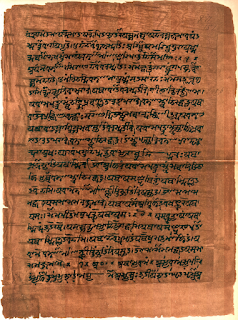

The Vedas

Meaning "wisdom" or "knowledge", the Vedas are traditionally said to be the revelations of sages during deep meditation, carefully preserved and considered to be the roots of Indian philosophy.

They are among the oldest sacred texts in the world, written approximately 1700-1100 BCE.

They were transmitted by oral tradition alone until around 1000 CE. They emphasize formal ritual and rites of passage like marriage, birth and death. 

They also introduce dana (compassion), karma (action and reaction), sacred dance and Ayurveda (sister sciences of yoga).

The Upanishads

Upanishad means “to sit at the feet” [of a Guru].

There were approximately 200 Upanishads written between 1000 BCE and 1500 CE including sections on philosophical theory and the practice of virtues like satya and ahimsa later also elucidated in the Yoga Sutras of Patanjali.

Topics include consciousnessbrahman, atman and maya, or the Source, the Self and the illusion that keeps us from seeing them as the same. It also proposes multiple etymological possibilities for Bija or “seed” mantra Om (Aum)

Of the great statements or mahavakyas of the Upanishads is Aham Brahmasmi, or loosely translated, "The Self and the Divine are one and the same." A similar sentiment can be said to be encapsulated in the sound symbol Om.


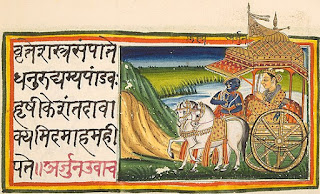
Arjuna and Krishna, the main characters in the Bhagavad Gita

The Bhagavad Gita

Written approximately 400 BCE, this text is just one chapter of an epic poem called  The Mahabharata.

It is one of the most heavily translated texts in the world. It highlights themes of  Dharma(duty and heroism), Yoga (and the paths of yoga, KarmaJnana and Bhakti), Moksha or liberation from suffering and the cycles of suffering on the “battlefields" of life.


One key definition of yoga in this text is:

Yoga karmasu kaushalam (Yoga is skill in action.) found in Chapter 2 verse 50.
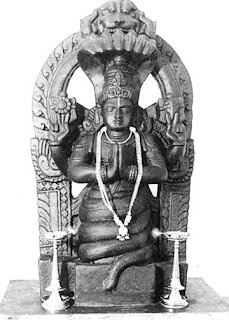

The Yoga Sutras of Patanjali

Also known as the Patanjala Yoga Shastra, written approximately 1600 years ago, (perhaps as late as 325-425 CE suggests recent research by Dr. Philipp Maas), Patanjali was the first to codify the teachings of yoga into a written format known as Sutras. Ideally these terse aphorisms are studied in the original language along with the first commentary called the Yoga Bashya.

Yoga Studies Podcast, Philipp Maas

Yoga Sutra Chant, The Sanskrit Channel

One of Patanjali’s key definitions of yoga is stated in the second line of the first chapter:

Yogaschittavrittinirodhah (Yoga is the stopping of the disturbed waves of the mind.)

In the second chapter, the author famously outlines a strategic "eight-limbed" path of practice which moves from external practices (yamas, niyamas, asana, pranayama, pratyahara) to internal experiences (dharana, dhyana, and samadhi). The path is known as Ashtanga or Raja Yoga. This practice is widely regarded as central to modern Hatha Yoga.

The sound symbol Om is mentioned in chapter 1, sutras 27-28 as the energy of manifestation which should be chanted repeatedly (japa) to encourage introspection and remove obstacles to the state of samadhi.

Q. How do these “definitions” compare/contrast with the modern interpretation of yoga in Canada?

Q. Is reading these texts in their original language necessary to achieve the goal of yoga?

Please note* This is by no means a full list of the foundational texts of yoga! It is only the tip of the tip of the iceberg! Please do explore further.

Krishna playing his flute


Mantras, Stories and Songs

Traditionally, Yoga was an oral tradition, passed from person to person keeping the teachings both alive and lively.

Singing, chanting, poetry and recitation, in fact all forms of sound, speech and writing are venerated in yoga philosophy. Personified as a beautiful Goddess, language is seen as a muse for creativity.

Storytelling is used widely as a teaching tool for students of all ages.

Music and sacred sound are central to the theory-practice continuum. They attract the attention, help maintain focus, reset dissonant physical and mental vibrations and uplift the environment.

Q. How can some knowledge of Sanskrit enhance my experience of yoga?


In Conclusion

I hope that I have passed on to you some of the reverence and enthusiasm I feel for the Language and Literature of Yoga, as well as points for reflection and some resources with which to follow up on your curiosity. 

Thank you for your time and attention today. Namaste!


Wednesday, 14 March 2018

Shruti Box Drone, in C

Many of you have expressed appreciation for the soothing sound of the Shruti Box I play during Yoga classes.

In the key of C, the drone is said to mimic the sound of Om or Pranava, the highest sound vibration, promoting feelings of peace, relaxation, harmony and unity, a valuable tool for overcoming suffering and the sense of limitation or maya.


While there is no substitute for live music, this recording on YouTube is a pretty good substitute.  It is a high quality recording, and long enough to use for meditation, chanting or overtone singing.

One of my students even suggested using it instead of an alarm clock in the morning.  What a great way to get up on the "right side of the bed"!

Friday, 11 July 2014

Hari Om Kirtan with Narayan Jyoti


Even if you can't make it to the live events during Raja Yoga Summer Camp's first Nine Nights of Sacred Sound, there are plenty of ways you can enjoy devotional chanting and uplifting vibrations.

I'm currently hitting replay over and over again on this Hari Om Kirtan with Narayan Jyoti!

Narayan Jyoti is one of my dearest bhakti brothers and fellow students, son of my teacher Sita Chaitanya of the Sivananda Yoga Retreat, Bahamas (now Swami Hridayananda), and direct disciple of Swami Vishnudevananda who gave him his name!

All his life he has been immersed in sacred sound.  Listen, you will feel it.

Thursday, 7 February 2013

This Weekend at Yoga Within

There are still a few spots available for this weekend's workshops at Yoga Within!

February 8 - 9 ~ Sanskrit for Absolute Beginners with Tara Woltjen

$82.50 + GST

Friday, February 8,  5:30 – 8:30pm (3hrs)

and Saturday, February 9,  1 – 4pm (3hrs)

The Sanskrit letters are said to be the sounds of the inner winds heard by the ancient yogis in deep meditation. Learn the basics of Devanagari script and transliterated Sanskrit in an easy, lighthearted way so that you too can resonate with these sacred healing sounds.

February 9 - 10 ~ Mantra Yoga the Complete Science with Yogi Amandeep

Feb 9th  - 1-6pm  $65, at door $75
Feb 10th – 10-2 pm $55, at door $65
 
Cost: for both days $111
  Mantra Yoga is perhaps one of the most ancient ways of self realization. “Man” means mind and “tra” means wave, Mantra is that which controls the waves of the mind.

According to the metaphysical science Mantras are primal sounds that alter the patterns of the mind and brain chemistry. Mantras are living conscious energy and have to be awakened to fully benefit from the sound, a process closely guarded secret.

The chanting of Mantras create blissful and peaceful mind. They bestow upon us the power to attain our goals and lift ourselves from the ordinary to the higher level of consciousness.  They give us the power to heal, attract prosperity, abundance and health. 

A very unique workshop on the detail science of mantra, how to awaken them, how they work, different forms of mantras, different stages in practise, their physiology in the body, their seats in the chakras, activation of 72,000 Nadis, their imprint in the mind and the whole science of mantra perfection.

Wednesday, 25 April 2012

The Meaning of Om

Om Painting by Omkari

My Guru appears to me in the most unexpected places and moments! 

Yesterday I was given a pop quiz on Om by a gas station attendant. 

He looked at me intently as I paid, and then gesturing to his own throat and my necklace asked, "You are knowing the meaning of this?"

Yak bone Tibetan Om necklace from Nepal

"Yes", I said "It's an Om, a Tibetan Om."

"Ok..." he grinned with a slight Indian head wobble, "but you are knowing the meaning?"

I said the first thing that came to my mind.  "Well, it depends who you ask."

"It's very good for concentration."  he stated matter-of-factly as he took the next customer's payment.

"Yes, very sacred.  Thank you!", I replied and scurried out. 

The whole way home I pondered the meaning of Om and how to express it in a nutshell. 
  • Om is the echoing hum of the universe.  Some astronomers refer to this as "interplanetary harmonics".
  • Om is Pranava, the breath of the Divine.  Religious folks might call it the Name of God.
  • Om is the Bija mantra, the seed of all creation.  Yogic cosmologists compare it to the Big bang theory.
  • Om is the fullness of the range of human vocalization.  Linguists consider it a progression of enunciation.
  • Om is the essence of the Vedas.  Vedantins believe chanting this mantra is as powerful as chanting all of the Vedas. 
Om represents the multitude of sacred trinities.  For example:
  • past, present and future
  • body, mind and spirit
  • Brahma shakti (creation), Vishnu shakti (preservation) and Shiva shakti (transformation or dissolution)
  • the three states of awareness; waking state, dreaming state and unconscious state

But how to best express what it means?

Om sticker from India

Ultimately the true meaning of Om cannot be expressed in words. 

At best, words can only point the yogini toward the direct experience like the teacher who points at the moon and admonishes the student for staring at his finger.

I heard a story in South India about the difficulty of expressing the meaning of Om: 

Kartikeya, the son of Lord Shiva approached Brahma, the Lord of Creation and asked him to explain Om.  Although Brahma claimed to understand and recited twelve thousand verses, Kartikeya found his explanation insufficient and was displeased. 

He approached his father, Lord Shiva who readily admitted to not fully understanding Om, and submitted himself humbly as a student to his son to receive the teachings on Om.

Om plate from India
So the real answer to the gas station attendant's question is in the heart of each individual to be revealed through practice over time.

Ramakrishna said that people immersed in the world cannot know the full meaning of Om, in fact, cannot even hear it.

As it says in Patanjali's Yoga Sutras 1.27-1.29:  (Please forgive my liberal translating!) 

The sacred word representing the Source of All is Om, or Pranava. (1.27)
Repeat this sound with deep reflection on its meaning. (1.28)
From this (repetition with reflection) comes Self-awareness and the removal of the obstacles to bliss. (1.29)

So, repeat Om.  Concentrate with reverence on all of the auspicious aspects of its significance and we will discover its true meaning for our Selves. 

Thank you, Gas Station Guru!  Your observation was a gentle and timely prompt!
 
Namaste!

Saturday, 14 April 2012

Om Namah Sivaya Gurave

Lord Shiva as Nataraja, the Cosmic Dancer

I'm excited to be teaching a session called Basic Sanskrit and More this morning at Yoga for Today as part of the Continuing Education Certification for Yoga Teachers.

This session offers an introduction to the Devanagari script, transliteration, linguistic diacritic marks, pronunciation tips, and basic Sanskrit vocabulary through a beautiful mantra from the Niralamba Upanishad dedicated to the Lord of Yoga, Lord Shiva.

It is a beautiful teaching on the Guru, both internal and external.  Well known by yogis, it is chanted in many different melodies (including the one on my cd!!)

To whet your appetite, here is a lovely version by Manorama.  See you there!


Can't make it today?  Not a yoga "teacher"?  Want to attend this workshop or offer it at your studio?  Email me at:  tarawoltjen@yahoo.ca

Tuesday, 6 March 2012

Om Mandala Painting


Beautiful inspiration for our Likhita Japa!

Om...

"The benefits of Mantra-writing or Likhita Japa cannot be adequately described. Besides bringing about purity of heart and concentration of mind, mantra-writing gives you control of Asana, control of Indriyas, particularly the sight and the tongue, and fills you with the power of endurance. You attain peace of mind quickly. By prolonged and constant practice the inherent power of the Mantra (Mantra-Sakti) will be awakened, which will fill your very existence with the Divinity of the Mantra."

- Swami Sivananda, an excerpt from the book, Japa Yoga.

Monday, 16 January 2012

Congratulations Y4T Class of 2012!

"To be appointed as a teacher is a great privilege.  If you are honest and if you are vigilant in delivering only what you have received from the lineage, and which you have verified through personal experience, then you will experience a great sense of joy in every moment of your life.  The important thing here is that you first put yourself in the shoes of those you are supposed to serve.  Then you will automatically know what to teach and how to teach." 

- Swami Rama, Himalayan Institute

Wednesday, 5 October 2011

Students at Yoga for Today Chant the Yoga Sutras!


Painting of Saraswati at the Sivananda Ashram in the Bahamas by Uma (Diane Woodward)

Lately Wednesdays have become my favorite day of the week.  I wake up looking forward to gathering in Satsang with the eager students of the first-ever Meditation and Yoga Philosophy class at Yoga for Today!

We've been exploring the deeper dimensions of Yoga through meditation, songs, stories, chanting in Sanskrit and writing in Devanagari, "vehicle of the Gods", the beautiful written script of Sanskrit, the ancient and sacred language of Yoga. 

Sanskrit Alphabet chart borrowed from IndiaDivine.org


In just three classes they have already learned how to draw the beautiful and auspicious symbol of Om and learned about it's components and the states of consciousness.


We also practiced writing the words Yoga and Guru in Devanagari. 

AND they have even been learning the first four Yoga Sutras of Patanjali by heart:
Atha yoganushasanam. 1.1
Yogas chitta vritti nirodhah. 1.2
Tada drashtuh swaroope vasthanam. 1.3
Vritti sarupyam itaratra. 1.4
You should hear it!

It's so exciting to see them with their notebooks and pens, on the edge of their seats, ready with questions and open to the less frequently discussed aspects of this practice.

Today we continue to celebrate Navaratri and the days dedicated to Saraswati, the Goddess of languages, arts, music and learning.

During this evening's class we will be chanting Om Aim Saraswatyai Namaha and writing Devi, praising the Goddess of Wisdom by her own means.

For the next couple of weeks we will continue practicing likhita japa (the devotional writing of mantras) and chanting the first four Yoga Sutras in anticipation of our last class. 

On that evening, a FREE PERFORMANCE AND REFRESHMENTS will be offered to our friends and families from 8-8:30! 

You are invited to join us to celebrate the timeless teachings of Yoga and these diligent and joyful Yogis and Yoginis of Today!

Om Aim Saraswatyai Namaha!

Thursday, 28 July 2011

Namaste!


                Om Gam Ganapataye Namaha
                 Om Gum Gurubhyo Namaha
                 Om Aim Saraswatyai Namaha
Woo Hoo!!! So I'm finally online, and looking forward to hanging out in Kali's Kitchen with you!  I'm new at this blog thing so forgive me for going "live" while still "under construction" but then, hey... isn't that what life's all about anyway? 

So, grab a cup of chai, listen to this beautiful invocation from Narayan Jyoti, take a look around at some of the great yoga links and resources I've already gathered here, and let me know what you think. 


I'll be adding more to the pages as often as I can, so come back soon! 

Om...