Showing posts with label upanishads. Show all posts

Wednesday, 2 February 2022

Grant MacEwan, The Language and Literature of Yoga

Namaste ЁЯЩП 

There is a saying in Sanskrit, the original language of Yoga that in any learning environment:

We learn 25% from our teachers, 25% from our peers, 25% we figure out ourselves and 25% we learn over time. 

That said, in addition to following along with this post in today’s class, I invite you to return and review the material and links, contemplate their relevance in your life and practice, and discuss them with your classmates. 

Rest assured, not all of it was meaningful to me from the beginning, and there is always more to learn, so if some of this feels like more than you’re ready for, that’s ok, you have a lifetime to practice.

I have included several questions for your consideration. Please feel free to voice your answers or further questions for discussion during class.


The Language and Literature of Yoga


Sanskrit is the primary classical language of India, and the original language of Yoga which is considered to be one of the six classical schools of Indian Philosophy, and includes the posture practice with which we are familiar.

The word Sanskrit means "perfected" or "refined" and has a rich tradition of creative, scientific, philosophical and religious texts. 

Although it is no longer widely spoken on a daily basis, it is still very much in use as a ceremonial language.

The beautiful script is known as Devanagari, or the "vehicle of the gods". 

The Cambridge Introduction to Sanskrit  is the best introductory text I have come across and is recommended for use in the Sanskrit classes at the University of Alberta. Click in the link and go to “Other Resources “ to find free alphabet charts, videos, worksheets and more.

Yoga Sutras in Devanagari and Transliterated Sanskrit from the Arlington Centre is a free PDF of the full Yoga Sutras of Patanjali with the diacritical marks. I’m not necessarily saying this is the “best” translation, but I do find the format and language approachable and helpful for beginners.

Q. Does language matter? Do names matter? What are some of the challenges and benefits of studying Yoga with or in the original language?


Transliteration Vs. Translation


Transliteration is transposing the sounds of one language into the script of another.  The use of standardized diacritical marks allows for accurate representation of sounds unique to a language.

Q. What challenges may a student encounter during the transliteration phase?

Translation is converting the words of one language into the words of another to facilitate understanding of the meaning of words or phrases. 

Q. What challenges may a student encounter during the translation phase?

Sanskrit in Modern English

English is a member of the Indo-European language family, one of several descendants of Sanskrit.

Many non-yoga specific words in English (jungle, bandana, pyjama, suture, jugular etc.) are borrowed or derived from Sanskrit. 

Many Sanskrit terms specific to yoga are becoming well known in English through the names of postures, authors, teachers and gurus.  Because their meanings may become lost in translation, often the original words are simply adopted into our modern language.

Here is an extensive and perhaps surprising list of English words of Sanskrit origin.

Q. What’s your favourite English word borrowed or derived from Sanskrit ?


Hints for Pronouncing Sanskrit Words and Names


Here are a few basic tips for pronouncing unfamiliar Sanskrit vocabulary, places and names:

- unlike English, Sanskrit is a phonetic language, meaning each and every letter is pronounced and always in the same way.

- transliterated letter "a" is pronounced "uh” as in "around" rather than "a" as in "after" or “Canada”

- each consonant is followed by a short “a” sound unless modified by other vowels. Letters do not have names in Sanskrit, they are known by their sounds.

- knowing where in the mouth the sound is produced will help you understand how to produce the sound

- there is a distinct and unfamiliar difference for English speakers between unaspirated and aspirated consonants ("b" vs. "bh" etc.)

- Sanskrit has no "th" sound, as in English “think" or "th" as in "this".  Rather the “th” in transliterated words indicates an aspirated consonant. For example, the word "Hatha"is pronounced "ha-tha" (“t" with a puff of air) rather than the common English mispronunciation of "Ha" (as in hat) "tha" (as in thug). Note* there are two such sounds which may seem similar to your ear but are actually produced in different areas of the mouth.

- longer words and names are often compounds of shorter words, so try breaking them down into syllables.

Here is a more extensive pronunciation guide should you wish to explore this matter further.

Q. What difficulties may arise when words or names are mispronounced?

Q.  What are some benefits of speaking more than one language?

Foundational Literature

Foundational texts are works of world literature which achieve a certain status for their presentation of ideas as representative of a culture or philosophy. 

Philology is the study of literary texts, their meaning, authenticity and historical context.


The Foundational Texts of Yoga
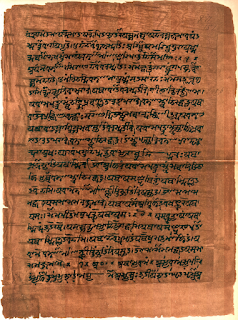

The Vedas

Meaning "wisdom" or "knowledge", the Vedas are traditionally said to be the revelations of sages during deep meditation, carefully preserved and considered to be the roots of Indian philosophy.

They are among the oldest sacred texts in the world, written approximately 1700-1100 BCE.

They were transmitted by oral tradition alone until around 1000 CE. They emphasize formal ritual and rites of passage like marriage, birth and death. 

They also introduce dana (compassion), karma (action and reaction), sacred dance and Ayurveda (sister sciences of yoga).

The Upanishads

Upanishad means “to sit at the feet” [of a Guru].

There were approximately 200 Upanishads written between 1000 BCE and 1500 CE including sections on philosophical theory and the practice of virtues like satya and ahimsa later also elucidated in the Yoga Sutras of Patanjali.

Topics include consciousnessbrahman, atman and maya, or the Source, the Self and the illusion that keeps us from seeing them as the same. It also proposes multiple etymological possibilities for Bija or “seed” mantra Om (Aum)

Of the great statements or mahavakyas of the Upanishads is Aham Brahmasmi, or loosely translated, "The Self and the Divine are one and the same." A similar sentiment can be said to be encapsulated in the sound symbol Om.


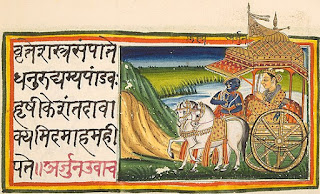
Arjuna and Krishna, the main characters in the Bhagavad Gita

The Bhagavad Gita

Written approximately 400 BCE, this text is just one chapter of an epic poem called  The Mahabharata.

It is one of the most heavily translated texts in the world. It highlights themes of  Dharma(duty and heroism), Yoga (and the paths of yoga, KarmaJnana and Bhakti), Moksha or liberation from suffering and the cycles of suffering on the “battlefields" of life.


One key definition of yoga in this text is:

Yoga karmasu kaushalam (Yoga is skill in action.) found in Chapter 2 verse 50.
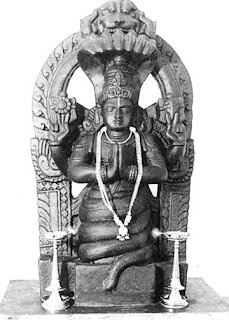

The Yoga Sutras of Patanjali

Also known as the Patanjala Yoga Shastra, written approximately 1600 years ago, (perhaps as late as 325-425 CE suggests recent research by Dr. Philipp Maas), Patanjali was the first to codify the teachings of yoga into a written format known as Sutras. Ideally these terse aphorisms are studied in the original language along with the first commentary called the Yoga Bashya.

Yoga Studies Podcast, Philipp Maas

Yoga Sutra Chant, The Sanskrit Channel

One of Patanjali’s key definitions of yoga is stated in the second line of the first chapter:

Yogaschittavrittinirodhah (Yoga is the stopping of the disturbed waves of the mind.)

In the second chapter, the author famously outlines a strategic "eight-limbed" path of practice which moves from external practices (yamas, niyamas, asana, pranayama, pratyahara) to internal experiences (dharana, dhyana, and samadhi). The path is known as Ashtanga or Raja Yoga. This practice is widely regarded as central to modern Hatha Yoga.

The sound symbol Om is mentioned in chapter 1, sutras 27-28 as the energy of manifestation which should be chanted repeatedly (japa) to encourage introspection and remove obstacles to the state of samadhi.

Q. How do these “definitions” compare/contrast with the modern interpretation of yoga in Canada?

Q. Is reading these texts in their original language necessary to achieve the goal of yoga?

Please note* This is by no means a full list of the foundational texts of yoga! It is only the tip of the tip of the iceberg! Please do explore further.

Krishna playing his flute


Mantras, Stories and Songs

Traditionally, Yoga was an oral tradition, passed from person to person keeping the teachings both alive and lively.

Singing, chanting, poetry and recitation, in fact all forms of sound, speech and writing are venerated in yoga philosophy. Personified as a beautiful Goddess, language is seen as a muse for creativity.

Storytelling is used widely as a teaching tool for students of all ages.

Music and sacred sound are central to the theory-practice continuum. They attract the attention, help maintain focus, reset dissonant physical and mental vibrations and uplift the environment.

Q. How can some knowledge of Sanskrit enhance my experience of yoga?


In Conclusion

I hope that I have passed on to you some of the reverence and enthusiasm I feel for the Language and Literature of Yoga, as well as points for reflection and some resources with which to follow up on your curiosity. 

Thank you for your time and attention today. Namaste!


Monday, 28 October 2019

PAC 156, Fall 2019

Namaste, thank you for welcoming me into your class today!

Here is a review of the material we covered and some additional links you may find helpful.

Please feel free to share any questions or feedback you have with your instructor, or in the comments below.

First, a link to the Teacher/Student chant we began with.  The post includes a beautiful classical recording by the late Ravi Shankar.

And here is a full summary of today's guest lecture. 

It was a pleasure to meet you, best wishes on your yoga journey, Om Shanti, Shanti, Shantihi!


Tuesday, 4 December 2018

Thank You, MacEwan University

Om Symbol at the Sivananda Yoga Retreat, Bahamas
Namaste,

Here are a few links, charts and tips to support today's guest lecture on The Language and Literature of Yoga.  

Feel free to browse around Kali's Kitchen.  It's a cozy place to explore the paths of Yoga and allow your own realizations, musings, and practice to "cook".

Enjoy!

We began today's class with the chant Om Sahana Vavatu in the call-and-response style of a traditional ashram or gurukulam.


The main topics introduced were:

The Language of Yoga:

The Foundational Literature of Yoga:

The Vedas
The Upanishads
The Mahabharata including the famous chapter The Bhagavad Gita
The Yoga Sutras of Patanjali

*Although we didn't discuss it in class, I also recommend the highly influential 15th-century text The Hatha Yoga Pradipika for a deeper understanding of the foundations of the path of Hatha Yoga specifically.


Key Definitions of Yoga:

The Vedas and the Upanishads: Aham Brahmasmi or "The microcosm (individual self) and the macrocosm (universal Self) are one and the same."

The Bhagavad Gita: Yoga karmasu kaushalam or "Yoga is skill in action"

The Yoga Sutras of Patanjali:  PYS 1.2 Yogash chitta vritti nirodhah or "Yoga is the stopping of the fluctuations of consciousness/the stilling of the mind."


Note* If you are in need of source materials for papers or your own personal study, I highly recommend archive.org, a non-profit digital library of millions of scanned documents and texts.

Final Chant:  Asato Ma Sadgamaya


Best wishes in your studies.  May your learning be brilliant and may it bring peace of mind, peace in the world and peace in your life.

Om Shanti,
Tara


Wednesday, 14 March 2018

Pavamana Mantra, the Chant for Enlightenment

At the end of every Yoga class, together we chant the Pavamana Mantra, from the Brihadaranyaka Upanishad.

Despite being chanted in Sanskrit, it is relatively easy for most beginners to pronounce, with a universal, non-denominational appeal in the form of a simple imperative:

"May I be inspired to keep moving from the untruth (or misunderstanding) into the truth, from darkness (ignorance or fear) into the light, transforming suffering into bliss."

Please note that this is my liberal translation.  Feel free to compare with others to enhance your own interpretation.

We chant it very simply, in the style I learned in my Yoga Teacher Training at the International Sivananda Yoga Vedanta Centres.


In my classes, we chant it accompanied only by the peaceful drone of the Shruti Box, but there are many other more orchestral versions which you may enjoy listening to or chanting along with.

Here are a couple to get you started:

The first version is an epic musical performance, most famous for appearing in the end credits of The Matrix and the second is a gentler, more traditional rendition from Ravi Shankar and George Harrison.

Jai!!!


Summary, PAC 156 Guest Lecture

Hanuman, by Betsy Schott
Namaste University of Alberta, PAC 156!

Thank you for inviting me to your class on Monday to present a brief "Introduction to the Language and Literature of Yoga".

In addition to this post from 2016 which I mentioned in class, you may like to check out this post from my lecture in 2015 which includes links to both of the chants we sang, a little bit about how yoga became popular in the west, and further explanations of the main paths of yoga.

If you have time, also check out this recording and transcription of Swami Satchidananda at Woodstock!

And to elaborate on the example I gave in class, of how the theory of yoga can enhance your practice, take a look at this new post about Hanuman and the asana that mimics his great leap to Lanka.

In summary, Yoga offers a whole tapestry of methods to enhance physical, mental, and spiritual well-being.

Aside from the well recognised physical benefits of Hatha Yoga, the Sanskrit language and foundational literature of yoga present numerous threads of insight into how we can live peacefully in a stressful world by developing our strength, flexibility, and resilience.

Songs, stories, myths and legends engage us in the lively timelessness of the oral tradition, and yoga's theory/practice continuum.

I encourage you to stay curious in your yoga practice.  You never know what will resonate with you until you experience it. 

As they say in India, "Sab kuch milega!", "Everything is possible!".

Om Shanti,
Tara


Monday, 27 February 2017

Stories of King Janaka: Yajnavalkya and the Light of Man

Yajnavalkya, Image Source: Wikipedia
Yajnavalkya is one of the earliest philosophers in recorded history.

He is famous for coining the word "Advaita" and for debating the nature of existence using the method of neti neti ("not this, not this") to discover the universal Self and ─Аtman.

He is also applauded as one of the rare Vedic scholars in history who encouraged and included women in the study of scriptures and debate, as seen here in a comment addressed to Maitreyi:

One should indeed see, hear, understand and meditate over the Self, O Maitreyi;
indeed, he who has seen, heard, reflected and understood the Self – by him alone the whole world comes to be known.
— Brihadaranyaka Upanishad

This story of Yajnavalkya and King Janaka, also from the Brihadaranyaka Upanishad, points to the Self as the source of illumination when all other lights have gone out.

Here is a longer narrated version of the same text for you to enjoy:

Brihadaranyaka Upanishad, Yajnavalkya speaks with King Janaka


Wednesday, 22 February 2017

What do the Yogis Say About Success?

Rama and King Janaka, Image Source, V&A Archives
Recently I was asked, "What do the Yogis say about success?"

Not feeling particularly "successful" myself at that moment, my response was, "I think I should ask a Swami!"

The reply I received from Swami Kashi said to read the stories of King Janaka, the wise Philosopher-King and father of Janaki, also known as Sita, wife of God-King Rama.**

Swamiji said,

"King Janaka is an example of a very rich, very successful person, who was a Brahma Jnani.  There's no contradiction between the two.  It is about your approach to your possessions and how you deal with it (such as generosity etc.) and not the numbers that make the difference."

Hahaha!  How characteristic that Swamiji's answer would require a little "homework"!

Authentic teachers always prompt us to investigate for ourselves.  Besides, those of you who know me as Swamiji does, know how much I loooooooove geeky yoga homework!

I suspect that such educational and entertaining research might benefit others as well, so I'm offering a sampling here, in a series of posts over the next several days titled, "Stories of King Janaka".

I hope you find them as amusing and inspiring as I do.

Thank you Sharon for your excellent question, and thank you Swamiji for your fitting reply!

**Important Update** Swami Kashi has informed me that actually, King Janaka, the father of Sita is NOT the same King Janaka mentioned in the Bhagavad Gita (3.20) and the Brihadaranyaka Upanishad.  Looks like I have some additional homework to do to make sure I'm sharing stories of the correct King Janaka.  Lol, otherwise, I'll have to change the title of the series to "Stories of King JanakaS"!


Monday, 20 June 2016

This is Perfect


The Isha Upanishad begins with a beautiful verse sometimes called the "Perfect Prayer":

Om Purnamadah Purnamidam
Purnat Purnamudachyate
Purnasya Purnamadaya
Purnameva Vashishyate
Om Shanti, Shanti, Shanti

Purna may be translated as perfect, but also, whole, complete, infinite.

This is a beautiful sloka to chant when we feel gratitude for the synchronicities in life.  

Alternatively, it is also valuable in those moments when we feel our experiences are imbalanced or imperfect.

Here is a sweet and soothing rendition by Shantala.


And here is beautiful traditional version for those of you interested in learning to chant along:


Thursday, 2 June 2016

University of Alberta, PAC 156 Guest Lecture

Mahamantra written in Devanagari
This is a special post for the students of the University of Alberta PAC 156 class.

Welcome to Kali's Kitchen!

Thanks for having me in last Thursday to guest lecture on the Language and Literature of Yoga!

I hope you find these reminders and resources helpful in your studies, it was a joy meeting you!

The Language and Literature of Yoga

Sanskrit is the primary classical language of India, and the original language of Yoga.

The word Sanskrit means "perfected" or "refined" and has a rich tradition of creative, scientific, philosophical and religious texts.

Although it is no longer widely spoken on a daily basis, it is still used as a ceremonial language.

The beautiful script (pictured above) is known as Devanagari, or the "vehicle of the gods".

You can see and hear the individual letters pronounced here.
You can find a short glossary of 108 yoga terms defined here.

Transliteration Vs. Translation

Transliteration is transposing the sounds of one language into the script of another.  The use of standardized diacritical marks allows for accurate representation of sounds unique to a language.

Translation is converting the words of one language into the words of another to facilitate understanding of the meaning of words or phrases.

Sanskrit in Modern English

English is a member of the Indo-European language family, one of several great (great great...) granddaughters of Sanskrit.

Many words in English (jungle, pyjama, suture, jugular etc.) are borrowed or derived from Sanskrit.

Many Sanskrit terms specific to yoga are becoming well known in English through the names of postures, authors, teachers and gurus.  Because their meanings may become lost in translation, more and more often the original words are simply being adopted into our modern language.

Here is a list of English words of Sanskrit origin.

Hints for Pronouncing Sanskrit Words and Names

Here are a few tips for wrapping your tongue around long unfamiliar terms:

- transliterated letter "a" is pronounced "a" as in "around" rather than "a" as in "after"

- there is a short "a" sound behind each consonant unless modified by other vowels

- recognize the difference between unaspirated and aspirated consonants ("b" vs. "bh" etc.)

- Sanskrit has no "th" sound, as in "think" or "th" as in "this".  Therefore the word "Hatha"is pronounced "ha-tha" (aspirated "t" with a puff of air) rather than the common mispronunciation of "Ha" (as in hat) "tha" (as in thug).

- longer words are often compounds of shorter words, try breaking them down.

Here is a helpful guide which reiterates the tips above plus several we didn't have time for.

Foundational Literature

Foundational texts are works of world literature which achieve a certain status for their presentation of ideas representative of a culture or philosophy.

The Foundational Texts of Yoga

The Vedas

Meaning "wisdom" or "knowledge", the Vedas are the revelations of sages during deep meditation carefully preserved and considered to be the roots of Indian philosophy.

They are among the oldest sacred texts in the world, written approximately 1700-1100 BCE.

They were transmitted by oral tradition alone until around 1000 CE and emphasize formal ritual and rites of passage like marriage, birth and death.

They also introduce dana (compassion), karma (action and reaction), sacred dance and Ayurveda (sister sciences of yoga).

The Upanishads

Upanishad means “to sit at the feet” [of a guru]).

There were approximately 200 Upanishads written between 1000 BCE and 1500 CE including sections on philosophical theory and the practice of virtues like satya and ahimsa later elucidated in the Yoga Sutras of Patanjali.

The main topics include consciousnessbrahman, atman and maya, or the Source, the Self and the illusion that keeps us from seeing them as the same.

Of the great statements or mahavakyas, in our class we focused on Aham Brahmasmi, or loosely translated, "The Self and the Divine are one and the same."

Arjuna and Krishna, the main characters in the Bhagavad Gita
The Bhagavad Gita

Written approximately 400 BCE, this text is just one chapter of an epic poem called  The Mahahtarata, which I affectionately refer to as "the original soap opera".

It highlights themes like Dharma (duty and heroism), Yoga (and the paths of yoga, Karma, Jnana and Bhakti), and Moksha or liberation from suffering and the cycles of suffering or the "battlefields" of life.

The key definition of yoga in this text is:

Yoga karmasu kaushalam (Yoga is skill in action.) found in Chapter 2 verse 50.

The Yoga Sutras of Patanjali

Written approximately 2000 years ago, 200 BCE – 200 CE, Patanjali was the first to codify the teachings of yoga into a written format known as Sutras.

Patanjali's key definition of yoga is in the second line of the first chapter:

Yogaschittavrittinirodhah (Yoga is the stopping of the disturbed waves of the mind.)

He also outlines a strategic "eight-limbed" path of practice which moves from external practices (yamas, niyamas, asana, pranayama, pratyahara) to internal experiences (dharana, dhyana, and samadhi) known as Ashtanga or Raja Yoga.
Krishna playing his flute

Stories and Songs, Enhancing the Practice and Presentation of Yoga

Yoga is an oral tradition, traditionally passed from person to person.  This method keeps the teachings both alive and lively.

Storytelling is used widely as a teaching tool for students of all ages.

Music and sacred sound are often employed to attract the attention, maintain focus, reset dissonant physical and mental vibrations and uplift the environment.

You can enhance your own enjoyment of yoga, and in teaching make your lessons more motivating and memorable through the use of instruments and voice.

You can read more about my Shruti Box here.

In Conclusion

I hope that I have passed on to you some of the reverence and enthusiasm I feel for the roots and traditions of yoga.

Each person is unique, and different approaches are suitable for different students.  I wish you a lifetime of curiosity and exploration into the techniques of yoga that appeal most to you.

Please post your questions and comments, your feedback is precious.

Namaste!


Sunday, 15 March 2015

Is There Anybody Out There?

Wow!  I can't believe its already March!  So where have I been since December?

Oh, mostly snowed in as per usual, but its been productive!

I've been making lots of all-natural, earth-friendly beauty products and cleansers, jams, jellies and bowls full of stove-top popcorn.

I've been studying the works of great Yoga Masters like Paramahansa YoganandaSri Ramakrishna and the classic Upanishads. (More on all that coming soon!)

And I've been busy teaching yoga to some wonderful private clients and the awesome kids and staff of the Children's Psychiatric Units at the Glenrose and Royal Alexandra Hospitals.

Its been a great winter and now that the sun is shining and things are brightening up, I'm excited to share it all with you!  So stay tuned for recipes, events, tips, classes, workshops and more!

Namaste and Happy 2015!

Thursday, 3 November 2011

The Teacher Student Chant

Om
Sahanavavatu sahanau bhunaktu
Sahaviryam karavavahai
Tejasvinavadhitamastu
Ma vidvishavahayai
Om Shanti Shanti Shanti

Let the Studies that we undertake be effulgent;
Let there be no Animosity amongst us;
OM. Peace, Peace, Peace.

(Recited before the commencement of education)  From the Yajurveda Taittiriya Upanishad 2.2.2

Many of you are familiar with this short chant from the Upanishads from the opening of the classes I teach. 

I learned it during my Sivananda Yoga Teacher Training in 1997 and loved it so much that I have chanted it out loud or in my heart before every Yoga class I've taken or taught since.

It reminds me that we are all, always, and in all ways both teacher and student in every situation. 

It reminds me to honor both roles and the divine Leela or play we partake in when we assume either role.

And it reminds me that on those rare and precious occasions when we have the karma to participate in formal sacred teachings, we must make a conscious decision to embody Namaste - to suspend criticism and judgement and choose to see the divinity in eachother rather than the differences.

Although the tune below is not the one I typically use, it is definitely one of my very favorites. 

It comes from the cd "Chants of India" on George Harrison's Angel Records Label and features the great Ravi Shankar on sitar. 

It is so beautiful I had to share it here. 

Thank you for chanting it with me.  May we enjoy learning Yoga together for as long as it takes...