This morning many, many beings are gathered to pay tribute to Darcy Belanger. Darcy was a popular member of my high school graduating class, a valued member of our local community and the beloved husband of my friend and fellow yoga teacher Amie.
Darcy was a Yogi in every sense. He was an earnest seeker of truth, a thoughtful steward of the environment, a generous and kind companion, a dedicated humanitarian, and a cheerful friend. He had a compassionate glow that knew no limits and inspired others to fulfill their personal potential. The moment I heard of his passing, I was struck by the "gap in goodness" his absence leaves.
Also to the work of Amma, the "Hugging Mother", Darcy's guru, who has been inspiring, uplifting, and comforting people around the world with her loving embrace for decades.
Darcy, Noble Soul, may your passing through the in-between be fearless. May you be as lovingly cherished in the afterlife as you are here on earth. Om Trayambakam x 108.
Sanskrit is the primary classical language of India and the source language of Yoga.
The word Sanskrit means "perfected" or "refined" and has a rich tradition of creative, scientific, philosophical and religious literature.
Although it is no longer widely spoken on a daily basis, it is used as a ceremonial language and is present (at least sporadically) in the vocabulary of most modern yoga practices.
The beautiful script pictured above is known as Devanagari.
Transliteration vs. Translation Transliteration is the transposing of sounds in one language into the script of another. The use of standardized diacritical marks allows for the accurate representation of sounds unique to a language.
When using Sanskrit terms diacritical marks are necessary to indicate sounds which do not exist in English. Unfortunately, they are inconsistently used in modern Yoga books and websites which can make pronouncing Sanskrit words difficult.
Translation is the act of converting the words of one language into the words of another to facilitate the comprehension of meaning.
In yoga, the original Sanskrit terms are often so nuanced, that it takes multiple words, sentences or even paragraphs in other languages to convey their connotation and intention.
Sanskrit in Modern English English is a member of the Indo-European language family, one of several descendants of Sanskrit.
Many common words in English (jungle, pajama, avatar, suture, bandana, shampoo, cashmere, ganja, jugular etc.) are derived from Sanskrit.
Many Sanskrit terms specific to yoga are familiar to modern yogis in their original language through the names of postures, authors, and texts.
Because their meanings can be obscured in translation, the original terms (asana, ashram, guru, swami, karma, mantra, mandala etc.) have been adopted.
Hints for Pronouncing Sanskrit Words and Names
Here are a few basic tips for reading and pronouncing Sanskrit:
- Sanskrit is a phonetic language. There are no silent letters, and each letter makes just one sound.
- The transliterated letter "a" is pronounced like "up" rather than "at". If there is a horizontal line above the "a" (ā) it indicates a long "aa" sound. In the example, Saṃsāra, we see two short and one long vowel.
- There is a short "a" sound following each consonant unless modified by other vowel sounds as in the word yoga.
- Sanskrit features unaspirated and aspirated consonants ("b" vs. "bh" and "t" vs. "th" etc.).
- Sanskrit has no voiceless or voiced digraph "th" sound, as in "think" or "this". Therefore the word "Hatha" (haṭha) is pronounced: "Ha-tha" ("hu" similar to "hut" + "tah" similar to "Utah", "t" with aspiration) as opposed to the common mispronunciation, "Ha" (as in hat) "tha" (as in thug).
- Transliterated "c" will always sound like English "ch" as in "church". This "ch" sound may also be aspirated, sometimes indicated with an extra "c" or followed by "h".
- Sanskrit contains retroflex consonants produced with the tongue curled to the roof of the mouth. Such sounds are absent in English and present a challenge for native English speakers.
- Long words are frequently compounds of two or more short words. Knowing some words that appear frequently in yoga vocabularies such as asana meaning "posture", pada meaning foot", ardha meaning half and ananda meaning "bliss" will make it easier to understand and articulate longer words and names.
Foundational Literature Foundational texts are works of world literature which achieve an authoritative status for their presentation of ideas representative of a culture or philosophy.
Following are a few of the foundational texts of yoga. There are others specific to the various paths of yoga, like Hatha Yoga, so please consider this short list to be an introduction.
Meaning "wisdom" or "knowledge", the Vedas are widely considered authoritative as representing the roots of Indian philosophy. They are among the oldest sacred texts in the world, written approximately 1700-1100 BCE.
They were transmitted by oral tradition alone until around 1000 CE, and emphasized formal ritual and rites of passage like marriage, birth, and death. They include peace prayers still chanted in yoga classes and ashrams today, and propitiations for promoting harmony and avoiding suffering.
The Vedangas are auxiliary Vedic disciplines including ritual instruction, astrology, linguistics, phonetics, and mudras important for maintaining the accuracy and aesthetics of oral recitation.
There were approximately 200 Upanishads written between 1000 BCE and 1500 CE including stories, philosophical theory, ethics and virtues like satya and ahimsa.
Major themes include consciousness, brahman, atman and maya, or the Source, the Self and the cosmic illusion that keeps us from seeing them as the same.
Of several "great statements" or mahavakyas , the one mentioned in class today was: Aham Brahmasmi, loosely translated, "I and the Source are one and the same."
Written approximately 400 BCE, this text is one chapter of an epic poem called The Mahabharata, which I affectionately refer to as "the original soap opera".
It highlights themes like Dharma (social duty and heroism), Yoga ("union" and the paths or practices that lead to the state of "unity", Karma, Jnana, and Bhakti), and Moksha or liberation from suffering experienced on the "battlefield" of life.
Yoga and the attributes of one who practices yoga are described many times in the Gita.
For the sake of simplicity, the key definition of yoga I have chosen to highlight from this text is:
Yoga karmasu kaushalam (Yoga is skillful action.) found in Chapter 2 verse 50.
Yogaschittavrittinirodhah or "Yoga is the state in which the disturbed waves of the mind have been stopped."
In the second chapter, Patanjali outlines an "eight-limbed" path of practice to stop the disturbed mental waves, including external strategies (yama, niyama, asana, pranayama, pratyahara) and internal meditative experiences (dharana, dhyana, and samadhi). This prescription is well known in modern yoga as Ashtanga or Raja Yoga.
Stories and Songs, Enhancing the Practice and Presentation of Yoga
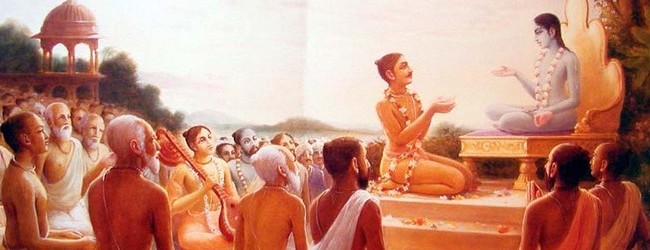
Yoga was originally an oral tradition, passed live from person to person. This method effectively kept the teachings dynamic and engaging for centuries. Eventually, the teachings were preserved in a written form, but the living tradition or parampara is as important today as ever.
As such, art, dance, music and storytelling are widely employed as teaching tools for students of all ages. Chanting, singing and other forms of sacred sound are employed to attract attention, maintain focus, reset dissonant physical and mental vibrations and uplift the individual and the environment.
You can enhance your own enjoyment of yoga, and in teaching make your lessons more motivating and memorable through the use of instruments and other artistic expressions.
In Conclusion Both the language and literature of yoga are accessible and relevant to the modern practitioner with a little effort and an open mind.
Modern yogis can access original manuscripts, translations, and commentaries as well as classes and videos on the foundational texts of yoga to gain knowledge and awareness of the roots, history, and practices of traditional yoga as well as yoga today.
Many source materials are available for free at Internet Archive.
Additional resources at the University of Alberta:
Yoga is an interdisciplinary study at the University of Alberta.
You can register for classes which examine the history, philosophy, religion, and language of yoga in various departments. For more information contact South Asian Studies.
Several years ago, I wrote this post about the beautiful teachings Yogini Queen Madalasa gave her infant sons when they cried.
In the cradle, she reminded them that they are not this body, this mind, and these emotions. She taught them Atma Jnana or the Wisdom of the Higher Self.
When I heard this rendition of the song I was brought to tears and knew it was time for an update.
Gabriella Burnel is a Sanskrit scholar and accomplished musician. To learn more about her and to read the full story from the Markandeya Purana click here.
According to the Hatha Yoga Pradipika, there are 72 000 channels in the body through which life energy flows. They intersect at hubs referred to as chakras, meaning "wheels". These chakras are knots which prevent the rising of Kundalini.
Tibetan Buddhist practitioners of Yoga have their own unique interpretation of this system of subtle channels which you can read about here, here and here.
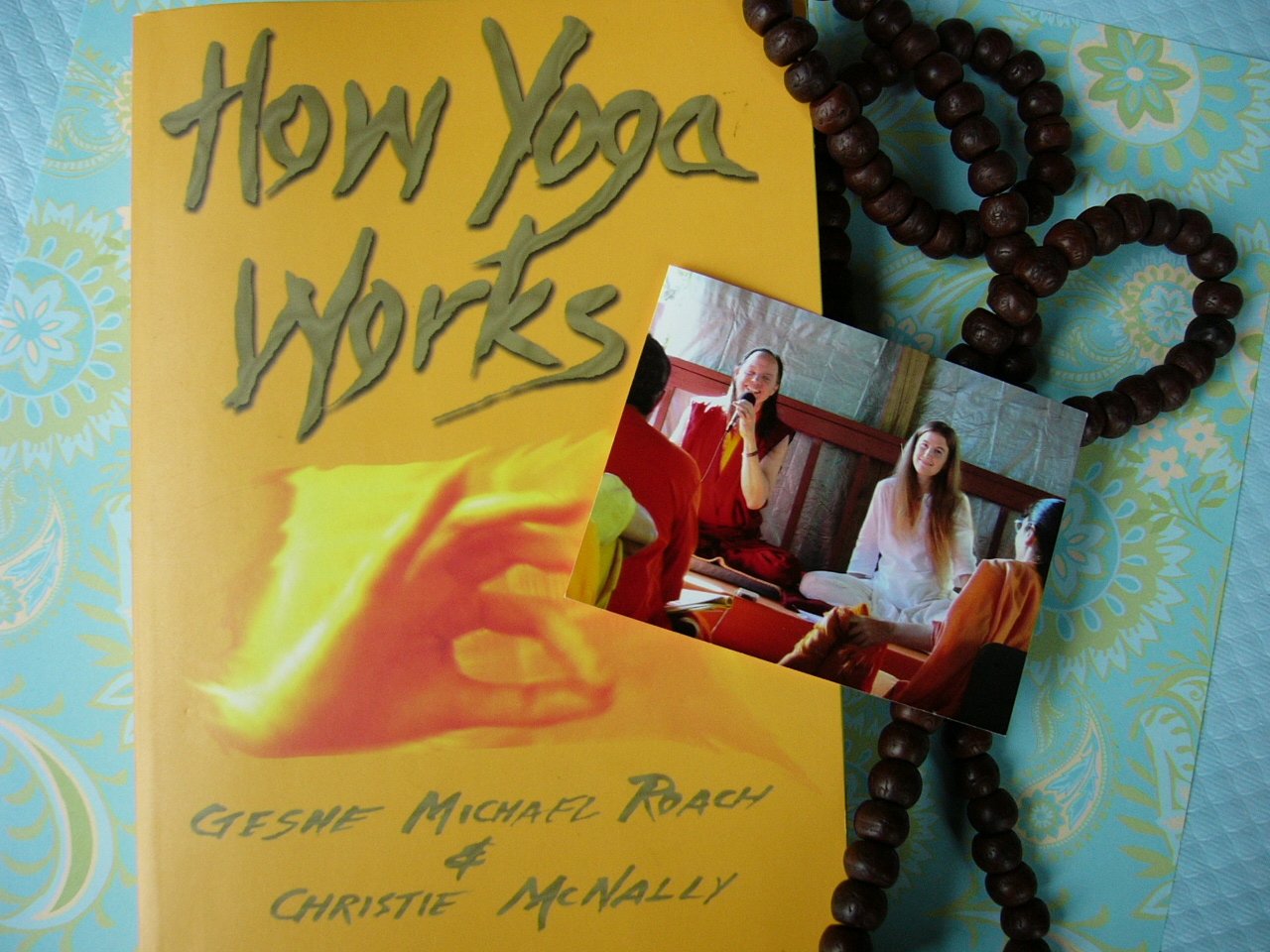
Geshe Michael describes the history of this series and the life of Lady Niguma here.
She is devouring, ferocious, and awe-inspiring. She is nurturing, tender and benevolent. In Hinduism the Goddess (Shakti) enacts the cycle of creation as envisioned by the Gods Vishnu and Shiva. The Goddess is represented in various forms throughout the history of art in India, and in classical Sanskrit religious literature, like the Mahabharata and Ramayana.
Recent scholarship asserts that many important characteristics of the female divine are derived from folk and oral traditions, as well as from aristocratic and literary ones. For example, the Goddess Kali can be seen to have roots in the fierce Goddesses of village traditions, and as such has been called by revered Hindu scholar A.K. Ramanujan a "Goddess of the Tooth". In contrast, he calls the benign and motherly Lakshmi and Bhudevi "Goddesses of the Breast." Featuring the return of the AGA’s 12th century Shiva Bhairava, the exhibition encourages the viewer to discover the multiplicity of forms and meanings in these images of the Goddess.